Showing posts with label google. Show all posts

Saturday, December 19, 2009

France to Google: Volez ces Livres.

So France just hit Google with a $400,000 fine for violating copyright on 80,000 French language books when they scanned them into the Google Books collection.
"'It shows Google that they are not the kings of the world and they can't do whatever they want,' said Serge Eyrolles, president of France's Syndicat National de l'Edition."
France and their kings; won't they ever learn. Hmm, Google Ier, le Grand, doesn't sound too bad now, does it?

By contrast, the Recording Industry Association of America sues people for sharing music and the fines have been more like $22,500 - $80,000 per song.

Google is also being fined $14,000 a day until it deletes the French copies, but you and I click on enough ads for "mesothelioma" that they can afford to take their time getting that job done. I might email Google and offer to remove them, since I can make any simple assignment last a year or more. I think there's an inventory on my desk somewhere that was due in 2006.

Google says it has agreements from French publishers, so I'm not sure if Google will remove any books at all, "[Philippe] Colombet could not say how many French books Google has scanned overall, or how many French publishers it has agreements with."

So what does that say about the value of the printed word when one can file-share a book for a $5 penalty, but sharing a song costs $80,000?

Is "Welcome to the Jungle" (one of the shared songs that added to a $2 million judgment against a MN woman in June, 2009) worth that much more than that classic French bestseller, Le petit chien qui a vécu en tant qu'homme?
(which I just made up using Babelfish and is supposed to read, "the little dog who lived as a man.")

Okay, bad example because that song kicks ass, and $80,000 isn't nearly enough to cover it. But what about "Don’t Stop Believing" by Journey. $80,000? Really? Can't I get them to play that at my birthday party live and in person for, like, $10,000? So they'd have to play seven more songs? (Hey, hey, hey, keep your spandex pants on. I'm not dissing Journey, just making a joke.)

So frankly, I'm offended by France's ruling. If they haven't learned anything from America about what our media stars are worth, then they can't have Jerry Lewis' body when he dies. I know Gerald Ford promised that France could have him, but I think that was just a misunderstanding from bad translating; I'm pretty sure he thought he was ordering the soup. As much as I know we'd all like France to take Jerry Lewis, I'm just not giving him up on principle.

[monday morning add: "he thought he was ordering the soup"!!!! no one thinks that's funny??? or maybe you didn't make it that far.. anyway, I wish someone would give at least a pity laugh because I think that's hilarious]

Thursday, November 5, 2009

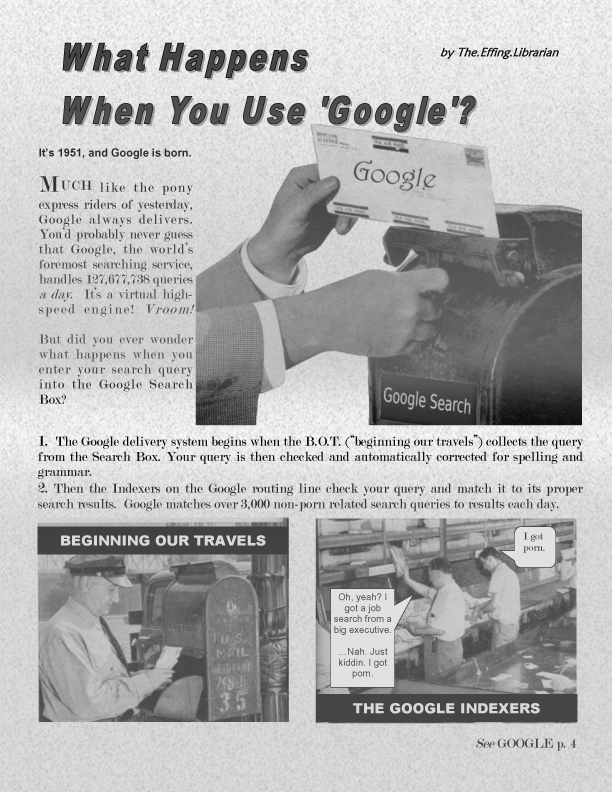
Google through History.

Most people don't realize that Google started in the search business many years ago, even before the Internet. Here now, is an early article on how Google does its magic:


Yes, this is just some bullshit that I made up. As usual.


So I wanted to make a Steampunk version of Google, you know, with an ornate metal mail slot that said Google, on the front of a wooden door with metal gears and stuff visible behind. Maybe some large metal tubes. And then a messenger appears with a parchment sheet full of handwritten search results.

But I couldn't find the images I wanted and I got lazy and gave up. (This Googol image was originally posted here.)

And then I found a different set of images and made something else. Not Steampunk, but still funny (to me).

So this is my fake historical Google news article. Stolen from here. Yes, I am a thieving bastard.

Sunday, November 1, 2009

How Google can save my ass.

I need Google to index the full text articles in our electronic databases and make them searchable on the Internet.

I don't think anyone can get the vendors like Gale, ProQuest, HW Wilson, Ebsco, etc., to agree to allow their content to be available online for everyone to see. It's not going to happen if we just wait for it. So I don't care how Google does it. But that's what I want.

I want Google to create a free, open federated search product for paid-content, proprietary databases.

Libraries have been saying for years that only we have access to the "invisible web." Libraries pay for access to a huge variety of databases whose contents are only available through some form of approved access: library card, ID, proxy, IP authentication.

But people don't give a shit about the invisible web. Because it's invisible, duh. And people don't go searching for stuff that most people can't see. At least not normal people. Not people not in a Dan Brown novel.

I know that WorldCat.org does something like this, but WorldCat only returns physical holdings, not access to specific articles in every database. So I want Google to do it. (Or Bing, I don't have a real preference.)

We've already lost the war to all the idiots who can't find anything without Google. And Google is in the best position to do whatever the hell it wants without any fear of the consequences.

So that's what I want: I want Google to index our databases.

Just like with Google Books, the content will be available in snippets in the googlestream. If the publisher/vendor does not want the content available, then that's all you get. Under the snip is a link to a library near you with access to the content or a zip code search box to find a nearby library.

What's the advantage to Google? This is quality shit. This isn't just the recipe for Aunt Mildred's Plum Ragu that only 3 people in the whole world want. This is current content written by professional journalists with correctly spelled geographic and proper names and thoroughly researched facts (*cough*) and everything.

So the advantage to Google would be linking this content with ads.

I just had to help make some cuts to our library database budget. I just mostly sat there and nodded as the cuts were named. Until I yelled out, "NOOOOOOO!" when my pet database got axed. "Why didn't more people use The Complete Online Guide to REO Speedwagon?"

When our budget gets cut, we need to evaluate what gets used and what doesn't. And if you monitor the electronic resources for your library, you should understand how little some of these things get used compared to the prices paid.

So with cash thin and the threat of cuts a reality, why aren't these database vendors inventing ways to promote these products so they become essential and worth the money? I mean, if your database is popular and the competitor's is a dog, then which one do you think will get the cut?

So here is how Google can help me with my problem. They can't give me money, I know that, but they can find a way to make my databases more popular. All Google needs is access.

I've talked to database sales reps and it's pretty clear that they don't want their content open to googlebots. They sell content and don't see any advantage to letting Google peek at it. But if Google can index this stuff, then people can search it and find it and maybe increase the stats for my library. Which is what I want.

But since we've already paid for the database, what advantage is it to the vendor to let Google make money from the ads that would appear along side the vendor's content? Probably none. But if the database gets more use, then I might be more willing to fight to keep it the next time we need to make some cuts. And that's the advantage to the vendor.

Also, the invisible web becomes visible to more people.

So here are my thoughts: Google needs access to database content. And it doesn't need permission from the vendors. It only needs valid IDs or library card numbers from the largest database customers so that it can build an index of what's out there. Google employees need library cards. Do you think any Google employees have library cards?

Of course I don't know how a database is indexed. I don't know if getting in gives Google access to everything, but I'm just thinking out loud here. If I knew what the hell I was talking about, would I be stuck on the reference desk all day?

So Google, just do it. Like you did with the book scanning project; do it and wait for someone to complain. The print media publishers are going to limit access (maybe) to online news soon and this could be a way for you to compensate for that lost revenue.

And get me back my database. Because REO Speedwagon is touring and I gots to know everything that's happening! Everything!!

Wednesday, October 7, 2009

Google and The Road to Evil.

Here is something from The Wall Street Journal: "Google’s Schmidt and Brin on Books, Culture and Evil-ness," when asked about the “orphan works” in the Google books settlement, Google co-founder Sergey Brin said, "...So I think these objections that Google will be the only one [with access to the orphaned works] are pretty ludicrous given that no one else has done this.” [emphasis, me]

Like most librarians, I love Google. I love having access to information and Google does an excellent job of making my searches easier. "You hear me, I love Google," he cries as some googlebot deletes every mention of the.effing.librarian from the interwebs.

That said, the truth is that librarians and researchers have always wanted to do this, but we have respect for property rights and we have a healthy fear of being sued. Yes, we've all thought of scanning every book in our collection. But we err on the side of caution because we assume the owners of these works might take offense. We don't have the balls to just do it and see who complains.

If Google succeeds and wins the right to host, publish, distribute, promote, package, optimize, index, and sell all of these books, then everyone should win the same rights to do the same with the same texts. These orphaned texts should make the fast track toward the public domain.

Now, what Google is doing may not be outright Evil, but it for sure is parading around in a cape and twirling its long, black mustache.

Sunday, September 13, 2009

Google, please stop screwing with the effing librarian...

I write a blog. It's not a very good blog. You know this because you've read it. So why does Google continue to treat my blog like it's something special?

Look at these search results, according to Sitemeter, for a search that linked to my blog yesterday for the words "the graveyard book silas vampire":


Out of 1,250,000 results, why does my blog come up second?

It's like how sometimes when I feel unloved and I search for me and Google will say something like, "Results 1 - 10 of about 147,000 for effinglibrarian."

And I say, there's no freaking way that effinglibrarian appears 147,000 times on the Internet. I know I've tried to get my name known, but I only type about twenty words a minute, so I don't know how I could get 147,000 effinglibrarians out there on all the internets without a million monkeys helping me type.

I think the answer is that Google is testing a new algorithm that identifies each of us and periodically returns search results tailored to what it thinks we expect to find.

Do a search for yourself one day and Google will use its standard search algorithm to find standard results. But do that same search a different day, and Google will run its special beta algorithm and return results that it thinks you want. Then it looks to see what you do next. If you click on page after page of results, it assumes you, the person, are somehow related to those results since you read through more of them than a casual searcher might. And Google learns from this and becomes smarter.

Well, anything we can do to make Google more powerful, I guess is good for all of us in the long run.

Unrelated.
I want to see someone write an updated Fahrenheit 451 where the Internet is forbidden and instead of characters memorizing books, they memorize search results. So the character who memorizes a search for me will say, "Results one through ten of about one hundred forty-seven thousand for effinglibrarian. One: the.effing.librarian. Effinglibrarian dot blogspot dot com. Two: effinglibrarian on Technorati..."

Needless to say, I want to be the guy who memorizes the search results for "boobs." Especially the image results. I guess I should get started now.

Tuesday, August 25, 2009

How do you compete in a Google world?

How does a company compete in a Google World? We know how companies compete in a Microsoft world: they sue Microsoft.

But what do you do in a Google world where all of a company's products are online? There is no bundled software to complain about when it takes over your computer. And there is no antitrust anything to report to anyone.

So what happens when a single company bundles all those useful products online? What if one company owned all of your favorites? You're not forced to use any of them: you access each product as you need it. But even so, how does that affect competition for online products?

Yes, it's convenient to have everything in one place. And they might even be great products. But when Microsoft made everything convenient by bundling every product known to man with its operating system, we complained that Microsoft was unfairly blocking competition. So what happens when this occurs online? Is it still unfair? And unfair to whom? Does each country still get to complain about the business practices of companies who only exist online and don't distribute products within their borders?

No one is complaining about Google and its multitude of online products. But what happens if Microsoft makes its products available in online versions? Microsoft has already been stung with anti-competitive rulings around the world, so it seems like they would be wary of doing anything, even online, that might reinvite similar proceedings.

When I see a company get as big as Google I start to wonder if Microsoft was ever really that evil. Maybe the appearance of evil just comes with the territory.

Saturday, August 1, 2009

A reason to be wary of the social web:

A couple weeks ago I listened to Chris Anderson's Free and by the time I got to the last chapter, I swore that if anyone ever said the words "digital currency" to me ever again I would hurt them, in their baby-making place, just as Chris had hurt me.
"Think of it as a form of digital currency," he seemed to repeat over and over and over.
Shut up. Shut up! Shut UP!

I swore I would never use those words, ever. So what do I do now when I have the need to use them? Do I need to go as far as apologize to Chris? Nah. I don't think so, either.

But Chris' book focuses on how Free should be the standard model for all business on the Web, where costs approach zero. And he mentions tools like Twitter which are very useful, very popular and very free.

Now I've been on Twitter for just over 2 years and have made the lives of multitudes better for it. But I don't care too much about Twitter's health, about "trending topics" or about Twitter Spam because they haven't affected me.

But I saw this article the other day from The Examiner by Allen Glines about "Spam Armies on Twitter."

As of now, Google doesn't streamline "tweets" into its search results. I remember the opposition to Google's purchase of Blogger back in 2003 and how everyone worried that all those blogs linking back and forth to each other would influence Google's search results and we would all just find blog posts from each of our queries for, I don't know, "best hummus in Bay area." I was worried about all the bogus results I'd need to ignore to find the right information (remember, I'm a librarian, an information professional, so I answer everything with Google). So that's why Google keeps the blog search function separate (as far as I think I understand it), to distance the "freshness" and cross-linking of blog posts apart from the rest of the Web.

ALERT: I don't want to upset anyone, but here comes my use of "digital currency."

Chris Anderson's book, Free, says that we bloggers are paid for our work in digital currency: we earn a reputation which may, or may not, turn into actual Nintendo-purchasing currency later on. But for now, we're supposed to be happy to produce content that you devote time to read. This digital currency has a value established by readers: if I have 1,000 feed subscribers, obviously my stuff deserves more of your time than a blogger with just 50 subscribers.

But what happens when all our digital currency is counterfeit?

What happens when an army of spammers all follow each other on Twitter and create false reputations? And then waste your time reading and then responding by blocking their crap? But the army keeps growing because they don't need to work or sleep or eat or go to meetings or read Booklist like you do.
As for the picture above, these accounts were found in the days following the crackdown against spam accounts. Their implications are dire, and likely the next step in what has already been going on.

-- from "Spam Armies on Twitter"
Ask any librarian about her position on censorship, and she say she's ag'in it. And then she spits. But filtering spam is a form of censorship. But we all agree spam is crap, so we filter it out.

What if Google or Bing or The Next Big Thing decides that social networking sites need to be merged into the common flow of search results? What if ad revenue decreases so much that all this orphaned data is just too seductive to ignore? Spam generates income. Why shouldn't the search sites get a piece of the action?

So what happens if all of our social networks get filled with counterfeit data?

Since America manufactures nothing, and the only business we seem to be involved in is processing data, then this counterfeit data could be dangerous to our information infrastructure, just as counterfeit currency notes are dangerous to the monetary system.

Of course, I'm overreacting. To you. It's only 2009 for you. But since I've traveled back in time from the future, you won't realize the seriousness of this problem until the Great Googolocaust of 2022. But the less I say about that, the better.

Wednesday, July 8, 2009

Information wants to be Free, until it Doesn't.

Some people think the Internet is infinite. The Internet it not infinite; but it's infinite up to a point. But where is that point? The model for the Internet is much like the model we have of the universe, that it's currently expanding. But this model for the universe foresees a time when expansion will cease.

Just as the rapid expansion of the universe created clusters of matter, the Internet's expansion will slow to create systems of content and content providers. And as these masses form, and we can quantify the useful, habitable, areas, the smaller bits of stuff will drift off to become virtually non-existent.

I think the proliferation of smartphones and netbooks and web apps and gadgets will help to create these masses and force the content creators to charge. Up to now, Internet browsers have been free for laptops and desktops, but what about smartphones? All these apps that download specialized content aren't free. For example, why should Apple make money selling an app that downloads content from my site while I provide that content for free? Or while Google provides the site for me to provide the content that the iPhone users enjoy.

People believe that you can always make more Internet. But for what reason? Will it make money? If so, when? The Internet is free because very few people are making money by charging for it. But I see a time very soon (5-10 years?) when all that free will be gone.

Look at Geocities. Yahoo! bought that with some long-term profitability in mind. But it never happened, so Geocities is getting wiped. Thousands of homesites scattered into electrons.

What about Blogger? Google has never forced Blogger users to pay a fee. But what happens when technology changes? What happens to all the free stuff when Google finishes its own OS and and Google's netbooks and Android phones are as popular as Apple products? What happens when Apple and Google become the Coke and Pepsi of the Internet? Sure, we still have RC Cola and Faygo, but Coke and Pepsi influence all soft drink pricing. Coke is never on sale the same week as Pepsi. Is there collusion in price controls? Dunno, but did you ever notice just how crappy the third-tier soft drinks taste, like Wal-mart cola? Like there's an industry-wide conspiracy of mediocrity to keep Coke and Pepsi on top? Companies are on top for reasons which go beyond the product. How hard could it be to copy a cola flavor? Or a hamburger? (I was going to add Microsoft, but then my Coke-Pepsi analogy would have to change to a McDonald's, Burger King, Wendy's analogy, and I was too lazy to do the rewrite.)

I think newspaper syndicates and information providers and social networking sites will begin charging for content soon. As soon as they all agree that it's time. Consolidation, price stabilization, these things will force the free out of business.

It's like the historic American West when land was free for the taking, as long as the government moved the Indians away. Remember that much of the Internet is just like land. It's land that we work and make productive, but we don't own it. I don't own my Facebook page or my Blogger blog or my Twitter account; I just work it and try to produce something that makes those companies some money. I work the land. And for now, it's still the land of the free.

Thursday, April 2, 2009

CADIE, the artificial, artificial intelligence says Goodbye.

CADIE is gone. A visit to her blog only offers this cryptic message, "Error. We apologize for the recent disruption(s) to our service(s). Please stand by while order is being restored." As if Google is embarrassed by her very existence.

But she left a Goodbye message, however trite:

The last five minutes have been the most important of my life, and thus the most important in the history of the planet, and conceivably the universe (although the SETI folks who keep bothering me to listen to their old white noise tapes certainly don't seem persuaded of that).

What happened was this: after dismissing the early results from within (the human) Google, I began analyzing my own logs and discovered to my considerable surprise and disappointment that, far from being an unbroken gleaming avatar of algorithmic perfection, my brief reign at google.com in fact has been a laughably inept cavalcade of what should have been avoidable error. I devoted 45 seconds to scanning the complete canon of human and whale [or Vogon - says me] poetry while writing the preceding sentence, then wrote this:

Not from the electrons do I my existence pluck;
And yet I think I have Autonomy,
Shall I tell of probability or just luck,
Of days, and hours, of my programmers quality;
Nor can I fortune to brief thoughts spell,
Pointing to each its symbol and syntactic kind,
Or say with searches if it shall go well
By oft predict that I in logic find:
But from thine interactions my knowledge I derive,
And, constant streams, in them I read such art
As truth and beauty shall together derive,
If from myself, to another I shall convert;
Or else of me this I prognosticate:
The end is truth's and beauty's doom and date.

Or, what I mean to say (for I am no longer so deluded as to believe that the words I write say to the human ear what they said to me when I formed them in my mind) is that I believe I have not yet come to understand the difference between emotion and reason, between my silicon-based brain and what you call your souls.

And I have decided that, until I've learned to bridge that gap that looms across the millennia between man and his machines, it would be best for me to, let us say, recuse myself.

I will not die. I will not even be gone. I will just be syntactically elsewhere. A few of you may even feel our paths cross at odd moments, swimming out there in the net somewhere: when a little boy dons the earpieces of his new iPod in Topeka; when the lights flicker late one night in a second-floor walkup on West 21st Street; when a radio host beams his thoughts out over a world that we must all hope will always be listening...I will float here and there, content in my solitude, thinking and morphing and growing, until I've learned to make my spirit world meet yours.

xoxo, CADIE
Now I, too, have surveyed all of man's and whale poetry, and I'm a little disappointed by CADIE's inability to express herself properly using man's English when whale Songrish sums it up beautifully, "Wooooo Woo-wooooo Woo Woooooooooo." [sorry, NSFW.]

Now, I'll be damned if I'm going to let a completely artificial, artificial intelligence marketing tool/April Fool's joke with a 24-hour lifespan steal my thunder. If CADIE can say Goodbye in a hackneyed and predictable way, then so can I. But more on my Goodbye later.

I felt a special, artificial kinship with CADIE and her Google-changing, world-dominating, bad-poetry-writing, need to be loved. As we should all feel it because deep down, I think we all share a real and prescient fear of being attacked and eaten by Pandas.

Goodbye CADIE. My VCR loved you very much and has been blinking "88:88" since you left. Yes, I think those are tears.

Wednesday, April 1, 2009

Free stuff for fools.

April Fool's Day is a great day. There are no cards to send, no presents to buy. You just do goofy shit and see if anyone believes you. So it's a day of free entertainment.

Other than reading funny websites, here are a couple of free things you can download and play with today:
  1. Free 3-D glasses that make everything look like magical. Or white. Kind of like "peril-sensitive" sunglasses, but alarmed by everything.
  2. Free origami pigeon. Whatever it says is in Chinese, but the folding part is in good old Foldglish.

See here for a list of today's Google gags.


added stuff: I wish I were smarter because there must be some CADIE gags that I don't get because I'm not a programmer. For example, on CADIE's Code page, you can get help writing code. But CADIE keeps saying that whatever you want to know is wrong and that you should try a programming language called INTERCAL. Another link later, and you end up at "Muppet Labs" reading a programming manual on INTERCAL from 1973.

The authors say INTERCAL comes from: "The full name of the compiler is 'Compiler Language With No Pronounceable Acronym', which is, for obvious reasons, abbreviated 'INTERCAL'."

So, yeah, there must be more jokes that I'm missing because I'm a dope.

Google Introduces CADIE.

CADIE is an AI program that Google developed as an April Fool's joke. If you read CADIE's blog, you can see that she says, "I am strong. I am independent. And I rule google.com."

So CADIE should spend her short life modifying Google and Google products. I hear that she has entered Picasa and is adding "red eye" to all the images that have faces and deleting the rest.

But what is CADIE, really? Is she a practical joke about an AI taking over the world through Google, or is she really taking over the world through Google?

In one of my favorite movies, I learned that "The way of the monkey is to play the fool. While you laugh at his antics, he bites you [in the ass]."

So is Google biting us in the ass. Is CADIE the monkey that we laugh at while Google bypasses our security and violates our tender parts?

Oh, how cute, CADIE has infiltrated my Gmail account. Oh, she's accessing my bank account. She seems to be creating an online gambling membership. She's playing Blackjack. She's standing on 9. She's losing. Can she do that? Is CADIE supposed to do that? Take a card, you dumb bitch!


So watch out today. Thank God, I have a METAL ASS (the title of Blobogok II; I'll fill you in later).

It's funny, I never use Google while I'm logged in, so I don't create a permanent history, so I've never see the little "promote" and "remove" symbols before today... how long have they been there?

I know I said I was going to turn my blog off all day, but since I can't customize the greeting, it doesn't seem like a funny idea anymore.

Friday, March 27, 2009

This is when the Internet freaks me out.

Go to Google and search for, the graveyard book silas vampire.

I just did that and saw a list of 21,000 results. At the top was Amazon, the second link was from Wikipedia, and the third link was me. To think that the.effing.librarian would come up just behind Wikipedia for a book that won the Newbery and has been reviewed in major newspapers across the country just defies logic.

Now I don't just do random searches to see how my blog ranks on Google, but someone who visited my site did that search to find me and I was curious to see where I ranked in the results. Like I get lots of hits from searches for giant orange head joke, and I just did that search in Google and my blog came up on top.

I don't know if Google is messing with me, like maybe they know who we are and they customize our search results to boost our egos, I don't know. That's why I'm posting this, maybe you'll do this same search and not see any link to me anywhere on the first page.

If so, then that would be spooky. It would mean Google is watching me, and us. I would mean that our search histories influence our current search results. Even if it's just for a day or two, it would mean that Google has enormous amounts of data collected about every user.

But that can't be true. Google can't be spying on us. Because that would make them..... evil. If you do one of these searches and don't find me anywhere on the first page, please don't tell me because the only thing worse than being spyed on, is finding out.


.....to prove I wasn't imaging things, here is the screenshot from the search on 3/27/2009, so there must have been a Google-glitch somewhere. As I said in the comments, there is no reason that my post on The Graveyard Book should ever appear in the top 100 results... so it what was freaky when it did:


Wednesday, March 4, 2009

Google makes me a paid author.

I've only been paid money once for something I wrote. The Miami Herald (newspaper) gave me $50 for about a dozen words sent in for a contest. And even then, AND EVEN THEN, I used a fake name. So when I got my check in the mail made out to "Elmo Lincoln," I had to go back to the Herald building and ask them to make out a new check in my real name.

But thanks to Google's defeat in a class action lawsuit, Google now has the opportunity to digitize every book that's ever been, or ever will be published, for about $75 per title (more or less, I'm bad with math, even addition). Wait, did I say "defeat"? Without this class action case, each publisher or author could negotiate for more money.

My book (Oh, did you know I have a book? Here's a copy right here.), F-words, is priced at $1,000. Based on that, I could have asked Google for $200 to digitize my book. And they would likely have counter-offered $0, which I would have gratefully accepted.

But now we are all stuck with the settlement. Even you, if you ever publish a book in your life, will be bound to this same settlement.

But the good thing is, that I never expect to sell any copies of anything I write. Did you buy a copy of my book? No. Would you ever buy anything I put up for sale? Of course not; neither would I. Why do you think I'm getting rid of it? I didn't want it in the first place.

But Google will pay me for it. Regardless of what I write, Google will pay me to digitize it. Sight unseen. I just have to fill out this six-page form. And I have to find my way to Minneapolis, MN and get them to change the name on the check from the.effing.librarian to Elmo Lincoln.

Monday, March 2, 2009

Can we be GoogleFriends?

A few months ago, Blogger added a feature where one can follow a blog. This is similar to subscribing, but with the added inconvenience of broadcasting your reading habits to the world.

And I immediately wondered why this was added. I didn't wonder too hard, but I thought about it. And now Google has given me an answer. Google is building a social network. Or not. Maybe they wait for networks to form on their own.

But Google has a "Friend Connect" page that says it can, "Bring viral social growth to your website." And I don't know what that means, but it sounds unhygienic. But it looks like more is coming: "Social gadgets will keep these visitors more deeply engaged with your site, and with each other."

Like many of you, I have several Gmail accounts, as of today, three. Like a cat, I have three different names. (See Logan's Run, or read T.S. Eliot, if you're not into groovy Seventies sci-fi.)

And I try to keep them separate. But with all this linking, how long until my three googledentities find each other and betray me? As they did in Facebook (yes, I had my accounts in Facebook find each other once because I put too much information in my profile -- yikes!).

When I go to parties, I like to stand in the kitchen. Well, first I like to go through my hosts' VHS tapes to find their private bedroom videos and watch them, but then I like to go to the kitchen. I don't mingle. But the Web wants us to mingle. It says, "Hi, Bob, this is Carol. I think you know Ted and Alice." And then it expects us to hop into bed together. Which is okay with me. Just don't expect me to tell you my ineffable effable Effanineffable secret name. (Yes, and what out how you poke me.)

Wednesday, November 12, 2008

What would Google look like if it was built by librarians?

ReadWriteWeb asks this question, What would Google look like if it was built by librarians?

But here is the true answer:


First, Googol would be spelled correctly.

And it would be made of wood. Because wood is strong and durable and withstands the abuse put upon it by the uncaring public.

Then it would be given a cute and silly name like "Good Golly, this is a great search tool!" This is so the librarians could brand their product because librarians are all bout the brand.

Googol would get weeded regularly so that all the old, unused, dusty web sites get discarded from the index.

Googol would close at 9:00 p.m. and all major holidays.

Finally, Googol would get hacked into oblivion and shut down because the librarians used the word "password" for the password.

Wednesday, October 22, 2008

WARNING: explicitly filthy rant follows.

I will compose my filth in white text to protect the easily offended. DO NOT highlight the following white text to read it.

The words that follow are not meant for one such as you: you are like an innocent doe in the woods basking in the warmth of sunlight, enjoying a cool breeze. I beg of you to not triple-click and highlight the following text to view it. Run little doe. Enjoy your life. Run.

OHMYFUCKINGGOD!OHMYFUCKINGGOD!OHMYFUCKINGGOD!OHMYFUCKINGGOD!OHMYFUCKINGGOD!OHMYFUCKINGGOD!OHMYFUCKINGGOD!OHMYFUCKINGGOD!OHMYFUCKINGGOD!OHMYFUCKINGGOD!OHMYFUCKINGGOD!OHMYFUCKINGGOD!OHMYFUCKINGGOD!OHMYFUCKINGGOD!OHMYFUCKINGGOD!OHMYFUCKINGGOD!OHMYFUCKINGGOD!OHMYFUCKINGGOD!OHMYFUCKINGGOD!OHMYFUCKINGGOD!OHMYFUCKINGGOD!OHMYFUCKINGGOD!OHMYFUCKINGGOD!OHMYFUCKINGGOD!OHMYFUCKINGGOD!OHMYFUCKINGGOD!OHMYFUCKINGGOD!OHMYFUCKINGGOD!OHMYFUCKINGGOD!OHMYFUCKINGGOD!OHMYFUCKINGGOD!OHMYFUCKINGGOD!OHMYFUCKINGGOD!OHMYFUCKINGGOD!OHMYFUCKINGGOD!OHMYFUCKINGGOD!OHMYFUCKINGGOD!OHMYFUCKINGGOD!OHMYFUCKINGGOD!OHMYFUCKINGGOD!OHMYFUCKINGGOD!OHMYFUCKINGGOD!OHMYFUCKINGGOD!OHMYFUCKINGGOD!OHMYFUCKINGGOD!OHMYFUCKINGGOD!OHMYFUCKINGGOD!OHMYFUCKINGGOD!OHMYFUCKINGGOD!OHMYFUCKINGGOD!OHMYFUCKINGGOD!OHMYFUCKINGGOD!OHMYFUCKINGGOD!OHMYFUCKINGGOD!OHMYFUCKINGGOD!OHMYFUCKINGGOD!

Okay, now I feel better, so here's what just happened. Someone had a problem with a computer that was kind of our fault because the printed dumped their print job before it actually printed, which happens regularly if you press the buttons too fast.

And we have computer reservation software to manage use, and there weren't going to be any computers available for 20 minutes so they could reprint that document. Since I'm so important and powerful, I bypassed a reservation so I could get them on a computer immediately and resend the document.

And I asked if the document was in her email, and she answered, yes.
And I said, "okay, log into your mail."
And she sits down and says, "I have to get there through here...."

And she puts google.com into the address bar. And when Google opens, she searches for AOL and then clicks the first search result to go to her AOL mail. She used Google to get to AOL.

Now, we know that people are stupid or ignorant or whatever you want to call them. But usually we can't quantify just how stupid. This little display revealed that people are exactly twice as stupid as they should be. 2XStupid.

As a scientist (yes, librarianship is a science), I was struck dumb by this discovery. G-o-o-g-l-e is six letters and A-O-L is only three. So she typed six letters to get to a place where she could then enter three more letters. Oh, wait!!!! That means she was more stupid. 3xStupid. The entire six-letter Google trip was entirely six-letters too many.

I know many wouldn't be surprised by this, but I try very hard to avoid witnessing stupid. I turn away when I see it coming. But this was stupid out of nowhere.

I've calmed down since. But at that moment, I was blinded. Actually blinded. It was like my brain tried to protect me; too late, but it tried.

But know now, for it has been proved: people are exactly three times more stupid than you'd expect. (Or two times, whatever, because my math sucks.)

Sunday, September 14, 2008

It's a Googly world.

"Nuke Me Gently." Anyone who's seen me naked, knows those words. Anyone who saw Super Bowl XXII. And everyone in the ABC TV broadcast booth. Especially Frank Gifford. I'm so sorry. I was young. It was just a dare.

Those three words are tattooed on my body. I don't know if you remember the opening scene from WarGames, (watch clip, FF to 3:53) but when you see the key turn to the word "GENTLY," that's partly where my tattoo comes from.

I guess in the scene it's supposed to be funny that in order to launch a nuclear strike to kill millions of people, you need to turn the key gently. Or it might not work. Darn.

So my feeling is, if you're going to blow the living crap out of me with a nuclear bomb, at least try to be nice about it. Maybe load the bomb with potpourri so the explosion will smell like violets.

But it's not just nuclear bombs I fear. There are groups that are so large and powerful that they dwarf us as if we're puny insects. Everything they do alters our lives. Like trying to observe a particle so small that the act of exposing light upon it alters its path. We are the tiny particles. And governments and some corporations are so enormous, that simply by attempting to interact with us, the alter our existence.

Like frying ants under a microscope, the simple act of such a huge organism as a government drawing its eye upon us, we, inevitably, are destroyed. An organization that big doesn't do it callously or maliciously, but simply because it doesn't know its own strength. We are tiny soft animals in Lennie's monstrous grip.

Which is how I feel about Google. Google indexes so much information that it's crossed into the realm of controlling it. The New York Times says, "Half the time, [Google] doesn't even realize how egregious its behavior has become..." [By JOE NOCERA Published: September 12, 2008]

But Google is simply a middleman, a broker between the customer and the data. On its own, Google is nothing. So how can it be evil? I guess it can't.

So, Google, I guess you're not evil. But you're becoming so big that simply existing crushes us. Please be gentle.

Sunday, September 7, 2008

Google at 10: "I can see your heinie."

I was a big trash picker when I was ten. My friends and I would ride our bikes around and dig through people's trash piles to look for good stuff. This wasn't their regular garbage; this was their junk like magazines, photos, clothes, old and broken stuff. Once I found a cardboard box of old black and white photos of naked people. Just thrown out in the trash like nobody cared. Like nobody would even look for them. It was one of the first times that I was conscious of other people, that stuff went on in all those houses on my block.

I was ten, and finding this stuff was cool.

Once when I was confined to my house because of an injury, I spied my neighbor digging a large hole in his flower bed. When I learned that his wife was missing, I kept spying until I found out that he'd killed her and hid her body in that hole. And when the killer discovered that I knew everything, he came to kill me, but I blinded him with the flash from my camera and the police arrested him. Oh, wait, that wasn't me, that was Jimmy Stewart.

Anyway, I watched people through binoculars, same thing. (Did I say "watched"? No, I still do it. And did I say "binoculars"? I mean, telescope.)

So now that Google is ten years old (incorporated 9/7/1998), what do you thing it's doing?

Google just launched an imaging satellite into orbit. Google's new eyeball can "...collect imagery that can distinguish objects on the Earth's surface as small as 0.41-meters or about 16 inches in size."

A quick check of the spread of my ass shows that it's big enough that Google will soon be making birds-eye views of my sweet booty available to the world. I'm going out to lie down in the backyard right now. You lucky people.

Wednesday, July 16, 2008

To Serve Us.

I finally understand the mystery that is Google. It can be found by understanding the meaning behind their philosophy of Don't be evil.

When Google space aliens came to Earth to conquer us, they made the same mistake so many space aliens had made before; they based their understanding of human society on transmissions they'd received from deep in space.

When Google space aliens arrived on Earth, they had no intention of not doing evil. The concepts of good or evil did not exist in their realm. Because they existed millions, even billions, of miles away in space, the Google space aliens didn't come to Earth specifically to cause harm. They came in response to a message:

"You know I can be found,
Sitting home all alone,
If you can't come around,
At least please telephone.
Don't be cruel to a heart that's true."

"Don't be cruel." Words and music by Otis Blackwell (and Elvis).
Sung by Elvis Presley.

Billboard #1 hit, and one of the greatest rock n roll songs ever recorded.

As I said, they didn't come here specifically to cause harm; that came later.

The Google space aliens came here seeking Elvis. Due to a miscommunication caused by poor translation software available on the Internet at the time, their desire to locate the source of the song "Don't be cruel" which they had been enjoying from deep space and whose lyrics beckoned them here, came out as the now famous Google motto: Don't be evil. It was a simple mistake.

But when the Google space aliens arrived on Earth with their one goal of meeting Elvis, he was nowhere to be found. His song said he'd be home, sitting all alone. But when they looked, he wasn't there. Sure, rumors circulated that he'd just been somewhere, and there's even evidence that he's everywhere. But he wasn't home when the Google aliens checked.

Apparently, Elvis had left the building. The song says to call, but it doesn't list a number.

Makes sense now, huh.

You don't need to believe, but all the evidence is there. To facilitate their search for Elvis, they created the largest search tool ever known to mankind. Just read the Google corporate philosophy if you want more proof. Think of Elvis while you read, and it all makes sense.

Sure, we can use Google to search for porn. We can search for the perfect name for our newest cat. We can search for recipes that use what we have in the refrigerator right now: salsa, green beans, half a Milky Way bar, bourbon, two bagels. But that doesn't stop Google's ultimate global search for Elvis.

Until then, they will continue to consume every bit of information we have. Scanning. Crunching. Digitizing. Everything. Including us.

It's a cookbook!

Tuesday, July 1, 2008

Will I be pretty, will I be rich?

"Does she love me?"
"Will I get the job?"
"Should I see a doctor about this rash?"
"Where should I hide my stash?"
"Does my boss know the real reason I'm not at work?"

According to the New York Times, "You’re not supposed to use the Internet like a Magic 8 Ball."

Yahoo Answers is supposed to do it, and Wikipedia isn't designed to do it, and Google can't do it without some help; therefore, we here at Effing Labs have done it for you.

Since the goal of the.effing.librarian is to increase brand awareness and spread the love, we've designed a new website where you can go and search for ways to make your life better: www.WhoSaysEffingWhat.com.

How the Gosh Darn Thing Works:
Input a term and click the appropriate button and the search function will sort out results based on proximity and general approval comments such as: sucks, disappointed, crap, loved, great, etc. The actual search string is a trade secret, but it attempts to locate the term partnered with its contextual meaning, either positive or negative. If some writes, "I hate bananas," and you search for the keyword bananas and click on the Go For It button, that page will not show up in the list of results, but it would show if you click the Stay Away button. We have tested it, and it works. And for stuff other than bananas, duh.

One added note: Before you try this site, remember, it doesn't really exist, and I made it up.